


You have seen the studies. You have heard the advice. Visualise your goals. Write them down. Put them somewhere you can see them every day. But here is the thing most productivity content glosses over: a vision board only works when it is specific, personal, and anchored to a plan.
A remote jobs vision board is not a collage of pretty beach photos and coffee shop aesthetics. It is a deliberate, purposeful visual tool that maps your remote career goals, your target roles, your income milestones, your timeline, and the life you are building — all on a single page that you look at every single day.
In this guide, we walk through exactly what to include in a remote jobs vision board in 2026, why visualisation works, what the most effective boards have in common, and a complete breakdown of the elements that will make yours a genuine career acceleration tool — not just a decorative mood board.
Why Vision Boards Work — The Science Behind Visualisation
Before we get into what to put on your remote jobs vision board, it is worth understanding why the exercise is valuable in the first place — because it is not magic, and it is not wishful thinking. It is neuroscience.
The brain’s Reticular Activating System (RAS) acts as a filter for the roughly 11 million bits of sensory information it receives every second, of which we are only consciously aware of around 50. The RAS decides what you notice and what you ignore — and it is directly influenced by what you focus on intentionally and repeatedly. When you look at a vision board every day, you are programming your RAS to prioritise information relevant to your goals: job listings, skill-building opportunities, networking moments, and career conversations that would otherwise pass you by unnoticed.
A 2011 study published in the Journal of Applied Sport Psychology found that mental imagery of goal achievement significantly enhanced motivation, confidence, and performance — results that have since been replicated across career, academic, and business contexts. Athletes have used visualisation for decades to improve performance. There is no reason the same principle cannot be applied to your remote job search.
The critical distinction that separates effective vision boards from decorative wishboards is specificity. Vague images of success produce vague results. A board that shows your specific target role, your specific income goal, your specific daily schedule, and your specific reasons for wanting a remote career gives your brain concrete targets to pursue.
What to Include on Your Remote Jobs Vision Board
The most effective remote career vision boards share a common structure: they balance aspiration with action, lifestyle with strategy, and emotion with data. Here are the ten essential elements to include:
1. Your Target Remote Role(s)
Be specific. Not just ‘remote job’ — but ‘Remote UX Designer’, ‘Email Management Virtual Assistant’, ‘Online Curriculum Developer’, or ‘Remote Medical Coder’. List two or three target roles maximum. The more specific you are, the more focused your job search becomes — and the more easily your brain can identify relevant opportunities in your daily environment.
Examples of specific target roles to include:
- Virtual Assistant — Calendar or Email Management
- Remote Medical Coder (CPC certified)
- Online Teacher or Curriculum Developer
- Social Media Manager or Content Strategist
- UX/UI Designer or Graphic Designer
- Instructional Designer or Corporate Trainer
- Copywriter or Technical Writer
- Aesthetic Industry VA
2. Your Income Goal
Put a specific number on it. Not ‘earn more money’ but ‘$60,000 per year by December 2026’ or ‘$4,000 per month in freelance retainers by Q3’. A concrete income figure gives your financial planning something to work backward from and makes your goal measurable, not aspirational.
Use the salary data from our Remote Jobs blog series as a reference point. UX designers earn $85,000 to $150,000 per year. Remote medical coders earn $44,000 to $92,000. Email management VAs in senior executive support roles earn $82,000 to $124,000. Calendar management VAs on freelance retainers can earn $4,000 to $5,000 per month. Pick a number that stretches you without being disconnected from the market reality.
3. Your Lifestyle Vision
This is the emotional core of the board — and the most important element for sustained motivation. Why do you want to work remotely? What does a successful remote work day actually look like for you? What does the freedom mean in practical, daily terms?
Be brutally specific. Not ‘flexibility’ — but ‘drop the kids at school every morning’, ‘work from Mombasa for two weeks every January’, ‘no more 90-minute commute’, ‘be home for dinner every night’, ‘start work at 6am and finish at 2pm’. The more vividly you can describe your target lifestyle, the more motivating your vision board becomes on the days when the job search feels discouraging.
4. Your Skills and Certifications Roadmap
A vision board without an action pathway is just a dream board. Include the specific skills, courses, or certifications that stand between where you are today and the role you are targeting. This transforms the board from passive aspiration into active planning.
Examples by target role:
- Remote Medical Coder: AAPC CPC certification (4–8 months)
- UX/UI Designer: Google UX Design Certificate on Coursera (6 months) + Figma proficiency
- Email Management VA: Google Workspace certification + SaneBox training + writing portfolio
- Online Teacher: TESOL certification + Canvas/Schoology LMS proficiency
- Instructional Designer: Articulate Storyline training + portfolio of 3 eLearning modules
- Social Media Manager: Meta Blueprint certification + Canva Pro + content portfolio
5. Your Timeline
Goals without deadlines are wishes. Add a specific timeline to your vision board — not just the ultimate destination, but the intermediate milestones that mark progress along the way. For example: ‘Complete Google UX Certificate by June. Build portfolio by August. Land first remote client by October. Replace full income by December.’
6. Market Data That Grounds Your Goals in Reality
Include one or two market statistics that reinforce the viability of your goal. Seeing a data point like ‘24% growth in remote hiring since 2022’ or ‘67,000+ remote jobs on FlexJobs right now’ or ‘1,516 email management VA roles on Indeed this month’ transforms your vision from a personal fantasy into a documented market opportunity. This is especially important on the days when self-doubt creeps in — concrete data is a powerful antidote to imposter syndrome.
7. A Daily Affirmation
Choose one powerful, present-tense affirmation that you read aloud every time you look at the board. Research in positive psychology consistently shows that self-affirmations reduce stress, increase persistence under challenge, and improve performance on goal-directed tasks.
Examples:
- “I have the skills, the drive, and the discipline to build a thriving remote career.”
- “Every application I send brings me one step closer to the life I am building.”
- “I am fully capable of earning a premium income from the comfort of my home.”
- “My experience and dedication make me exactly what remote employers are looking for.”
8. An Inspiring Quote
Choose one quote that genuinely moves you — not because it is popular on Pinterest, but because it speaks directly to your specific journey. If you are afraid of leaving a stable job for a remote career, find a quote about courage. If you are struggling with the pace of your progress, find a quote about consistency. If you are overwhelmed by how much there is to learn, find a quote about starting before you feel ready.
9. Your Top Five Target Companies or Clients
Knowing the specific companies or client types you want to work with sharpens your entire job search strategy. Include five dream employers or client profiles on your board. For remote employees, this might be companies like Canonical, Guidewire, Optum, or Kaiser Permanente. For VAs and freelancers, it might be a client type like ‘a med spa owner in the US with 3 locations’ or ‘a B2B SaaS founder with a team of 10 to 50.’ Specificity drives action.
10. Your First Step — Written as an Action
Every vision board should end with one non-negotiable action item: the single most important thing you can do today — or this week — to move toward your goal. Not a vague commitment, but a specific, time-bound action: ‘Enrol in the AAPC CPC course by Friday’, ‘Send three VA pitches on LinkedIn by Wednesday’, ‘Complete the Google Workspace certification by next Sunday’. Write it in the present tense. Write it in bold. Put it somewhere impossible to ignore.
Your Remote Jobs Vision Board at a Glance
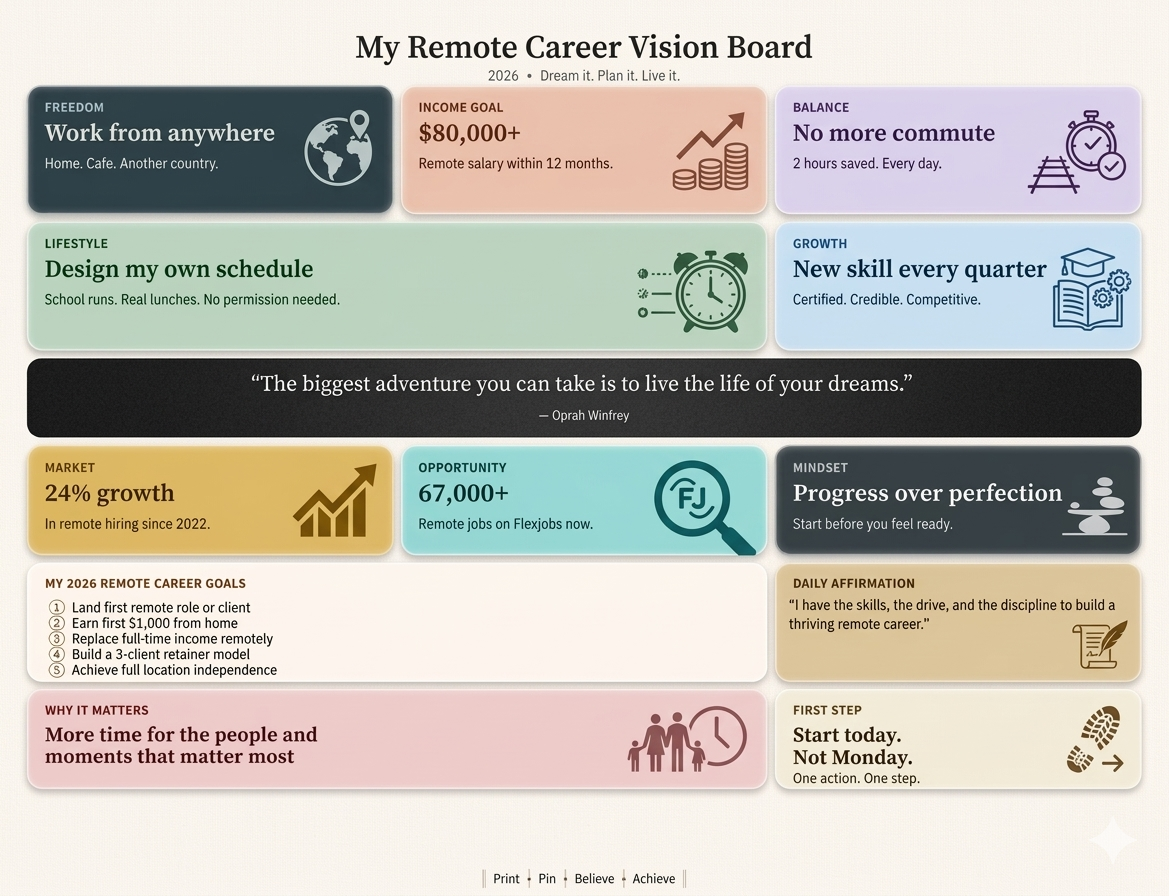
Here is a sample layout of the key elements every remote career vision board should contain, arranged as a one-page visual reference:
| FREEDOM Work from anywhere Home. Cafe. Another country. | INCOME GOAL $80,000+ Remote salary within 12 months | BALANCE No more commute 2 hours saved. Every day. |
| LIFESTYLE Design my own schedule School runs. Real lunches. No permission needed. | GROWTH New skill every quarter Certified. Credible. Competitive. | |
| “The biggest adventure you can take is to live the life of your dreams.” — Oprah Winfrey | ||
| MARKET 24% growth In remote hiring since 2022 | OPPORTUNITY 67,000+ Remote jobs on FlexJobs right now | MINDSET Progress over perfection Start before you feel ready. |
| MY 2026 REMOTE CAREER GOALS 1. Land first remote role or client 2. Earn first $1,000 from home 3. Replace full-time income remotely 4. Build a 3-client retainer model 5. Achieve full location independence | DAILY AFFIRMATION “I have the skills, the drive, and the discipline to build a thriving remote career.” | |
| WHY IT MATTERS More time for the people and moments that matter most | FIRST STEP Start today. Not Monday. One application. One pitch. One course. | |
How to Use Your Remote Jobs Vision Board Effectively
Creating the board is step one. Using it consistently is what actually drives results. Here is how to build the vision board habit:
- Put it where you cannot avoid it. Print it, laminate it if you like, and stick it somewhere that is in your eye line every single day — above your desk, on your bedroom wall, on the inside of your wardrobe door. A vision board you have to go looking for loses most of its power. The goal is unconscious daily exposure.
- Spend 60 seconds with it every morning. Before opening your email, before checking your phone, spend one minute looking at your board. Read the affirmation aloud. Look at the income goal. Look at the lifestyle vision. Let yourself feel what it will feel like when you get there. This is not woo — it is intentional programming of your focus for the day.
- Review and update it every 90 days. Your goals will evolve, your target roles may shift, and your timeline will need adjusting as you progress. A static vision board becomes wallpaper. A living, updated one stays powerful. Every 90 days, ask yourself: what has changed? What needs updating? What new goal deserves to be added?
- Pair it with a weekly action list. The vision board handles the emotional motivation. A weekly action list — three to five specific tasks that move you toward the board’s goals — handles the practical execution. The two work together: the board reminds you why, the list reminds you what to do today.
- Share it — selectively. Telling the right person about your remote career goal creates positive accountability. Tell one trusted person who will encourage rather than undermine your ambition. Research shows that making your goals public to supportive people — not just posting them anonymously on social media — significantly increases completion rates.
Digital vs. Physical: Which Vision Board Format Works Best?
Both formats work — but they work differently, and the best choice depends on your daily routine and how you learn and process goals.
A physical vision board printed and pinned to your wall wins on passive exposure. You do not have to actively open it or navigate to it — it simply exists in your visual field throughout the day, quietly reinforcing your goals every time you glance at it. This passive exposure is the vision board’s greatest advantage, and it is most powerful in a physical format.
A digital vision board created in Canva, Miro, or Pinterest wins on accessibility and aesthetics. You can set it as your phone wallpaper, your laptop screensaver, or your browser home page. It is easy to update and easy to share. If your desk setup does not easily accommodate a wall display, a digital board as your phone wallpaper can generate the same daily exposure.
Our recommendation: do both. Create a high-resolution digital version first — then print it, laminate it, and hang it somewhere prominent. The five-minute investment of printing your vision board could be the best use of your time in your entire remote job search.
Your Remote Career Starts With a Clear Picture of Where You Are Going
The remote job market in 2026 is the most opportunity-rich it has ever been. Global remote hiring is up 24% since 2022. FlexJobs alone carries over 67,000 active remote listings. The roles we have covered in this series — virtual assistant, email manager, calendar VA, medical coder, online teacher, creative professional, instructional designer, and more — all offer genuine, competitive salaries and the ability to work entirely from home.
But opportunity without direction is just noise. A remote jobs vision board gives you direction. It turns a vague aspiration — ‘I want to work remotely someday’ — into a specific, visual, emotionally resonant plan that your brain actively works toward every single day.
Print the sample board from this article. Add your specific income goal. Write your own affirmation. Put it on your wall. Look at it tomorrow morning. Then take one action — one application, one pitch, one course enrolment, one LinkedIn connection — toward the life it represents.
The remote career you want is not as far away as it feels. It starts with knowing exactly what you are building toward.