


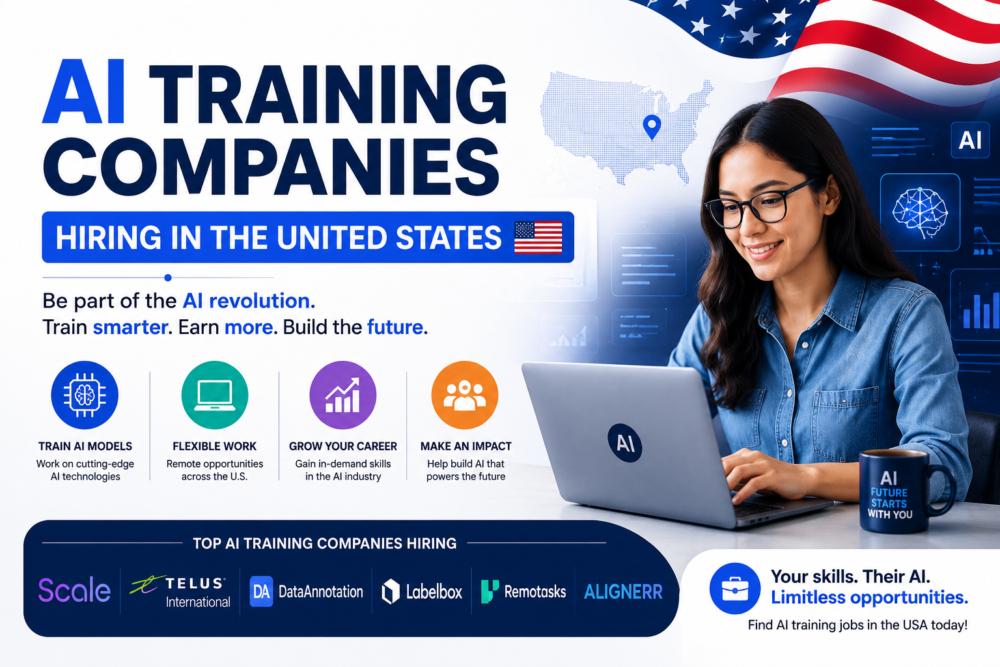
A Comprehensive Industry Guide: Companies, Roles, Salaries & How to Get Hired
AI trainer job postings surged 150%+ over the past two years. The global data annotation market hit $1.69 billion in 2025 and is on track for $17.10 billion by 2030. Major frontier AI labs — Anthropic, OpenAI, Google DeepMind, and Scale AI — are actively competing for human talent across roles ranging from $15/hr entry-level annotators to $1,000/hr domain experts. This report covers every major employer, role, salary, required skill, and career pathway in the US AI training industry.
1. Introduction: The Humans Behind the Machine
Artificial intelligence dominates headlines in 2026 — in hospitals, law offices, self-driving vehicles, financial markets, and smartphone assistants. But behind every large language model, image recognition system, or AI-powered chatbot is an often-invisible workforce of human trainers, data annotators, and safety evaluators. These professionals teach machines how to think, respond, and behave responsibly. And right now, demand for their skills is at an all-time high.
Job postings for AI trainers have surged more than 150% over just two years, making it one of the fastest-growing career categories in the entire United States labor market. The World Economic Forum, citing LinkedIn data in January 2026, confirmed that AI has already added 1.3 million new jobs globally — with Data Annotators explicitly named as a top growth occupation. Upwork’s 2026 In-Demand Skills Report ranks annotation as the single top-growing skill in data science.
Major employers — including Scale AI, Anthropic, OpenAI, Google DeepMind, Surge AI, Appen, DataAnnotation.tech, Outlier AI, and dozens of specialist platforms — are actively competing for talent across a wide spectrum of roles.
2. Understanding the AI Training Ecosystem
2.1 What Is AI Training?
Building a useful AI model is not simply a matter of writing code. Machine learning systems learn by example — they require vast quantities of labeled, curated, and evaluated data to develop accurate, helpful, and safe behaviors. AI training is the end-to-end process of creating, structuring, and refining that data. The work encompasses several distinct activities:
- Data Annotation: Labeling raw inputs — images, audio, video, text — with descriptive tags so a model can learn to recognize patterns and make predictions.
- Human Evaluation: Rating and comparing model-generated outputs for accuracy, helpfulness, tone, and safety.
- Reinforcement Learning from Human Feedback (RLHF): Human trainers rank competing model responses, providing feedback signals that guide iterative model improvement through reward modeling.
- Red Teaming: Deliberately probing AI systems for harmful, misleading, or unsafe outputs by attempting adversarial scenarios.
- Synthetic Data Generation: Creating artificial but realistic training examples to supplement real-world data, reduce bias, and address data scarcity in specialized domains.
- Domain Expert Evaluation: Using professional expertise (medical, legal, scientific) to verify that AI outputs meet professional standards.
Data preparation and annotation alone consumes over 80% of the total time in a typical AI project lifecycle, according to industry benchmarks.
2.2 Why Demand Is Exploding in 2026
- The proliferation of large language models (LLMs) and multimodal AI systems has dramatically increased the volume and complexity of training data required.
- The shift toward high-stakes AI applications — healthcare diagnostics, legal research, autonomous systems — has intensified demand for domain experts rather than general-purpose annotators.
- Growing regulatory pressure from governments to produce accountable, explainable, and bias-free AI requires dedicated human review and safety evaluation teams.
- Fierce competition among AI labs has made training data quality a key strategic differentiator.
- Each major frontier AI lab now spends roughly $1 billion per year on human-generated training data (Time Magazine, 2025).
2.3 Market Size and Growth Trajectory
- Global data annotation and labeling market: $1.69 billion in 2025, projected to grow to $17.10 billion by 2030 at a 28.4% CAGR (Grand View Research).
- AI training dataset market: forecast to reach $9.58 billion by 2029 from $2.82 billion in 2024 — 27.7% CAGR (MarketsAndMarkets).
- Data annotation tools market: $3.07 billion in 2026, projected to hit $12.42 billion by 2031 (Mordor Intelligence).
- North America holds ~59% of global data annotation market revenue.
- Annotation expertise demand grew 154% year-over-year — fastest-growing skill in all of data science (Upwork 2026).
3. The Major AI Training Companies Hiring in the US
The US AI training hiring landscape spans three tiers: large specialized annotation platforms, direct-hiring frontier AI labs, and a growing ecosystem of boutique domain-expert networks and emerging platforms.
3.1 Company Overview at a Glance
| Company | HQ / Founded | Workforce | Specialty |
| Scale AI | SF, CA / 2016 | 240,000+ contractors | Enterprise annotation, autonomous vehicles, gov AI |
| Surge AI | SF, CA / 2020 | 1M+ vetted contractors | RLHF, LLM alignment, preference ranking for frontier labs |
| Appen | Sydney / 1996 | 1M+ global contributors | Multilingual NLP, speech recognition, search relevance |
| DataAnnotation.tech | US / 2020 | Large US-based base | Text evaluation, AI response rating, writing quality |
| Outlier AI | US / 2022 | Tens of thousands | STEM, coding, domain expert evaluation |
| iMerit | SF, CA / 2012 | ~5,000 on-staff | Healthcare AI, medical imaging, regulated domains |
| Sama | SF, CA / 2008 | ~5,000 professionals | Ethical sourcing, diverse & safe workforce model |
| Labelbox | SF, CA / 2018 | Platform + managed team | Self-service labeling platform with hybrid managed services |
| Remotasks | US / 2017 | Large global crowd | Beginner-friendly, gamified onboarding, entry-level tasks |
| Prolific | London / 2014 | ~200,000 participants | Research-quality participants for academic AI evaluation |
3.2 Geographic Hiring Scope & Official Links — Quick Reference
The table below provides official links and a clear breakdown of whether each platform accepts workers from the US only, or also from Africa, Asia, and other regions globally.
| Company | Official Link | Hiring Scope | Open to Africa / Asia? |
| Scale AI / Outlier | outlier.ai | 100+ countries — US, UK, CA, AU, NZ, India, Philippines, most of Europe, Latin America, parts of Africa | YES — Most inclusive high-pay platform |
| Surge AI | surgehq.ai | Global sign-up, but only ~30–40% of projects open to non-US workers. Specialty languages increase access. | PARTIAL — Growing Africa presence (Kenya) |
| DataAnnotation.tech | dataannotation.tech | US, UK, Canada, Australia, New Zealand ONLY. Accounts from other countries are closed within 48 hours. | NO — Strict country filter |
| Appen | connect.appen.com | 170+ countries globally. Pay is location-dependent ($3–$15/hr). Truly global reach. | YES — 170+ countries including Africa & Asia |
| iMerit | imerit.net/careers | Full-time employment model. Primary operations in US and India. Not a gig platform. | YES — Strong India/Asia presence (full-time) |
| Sama | sama.com/careers | Full-time staff in East Africa (Kenya, Uganda) and Asia. One of the best options for African workers. | YES — Africa-focused (Kenya, Uganda, Asia) |
| Labelbox | labelbox.com/careers | Corporate/full-time roles primarily US-remote. Managed annotation (Alignerr) draws from broader pool. | PARTIAL — Full-time US; contractor pool is wider |
| Remotasks | remotasks.com | Now merged into Outlier AI. Global — major presence in Africa, Southeast Asia, Latin America. | YES — Redirect to Outlier.ai |
| Prolific | prolific.com | Primarily US and UK, with some European countries. Not broadly open to Africa or most of Asia. | NO — Mainly US/UK/Europe only |
| Anthropic | anthropic.com/careers | Primarily US-based full-time roles (SF HQ). Most roles require US work authorization. | NO — US auth required for most roles |
| OpenAI | openai.com/careers | Primarily US-based. AI Residency program for career-changers. Most roles require US work auth. | NO — US auth required for most roles |
| Google DeepMind | deepmind.google/careers | Global offices: US, UK, Canada, France, Germany and more. One of the most internationally open frontier labs. | PARTIAL — Global offices but competitive |
| OpenTrain AI | opentrain.ai | Global — 180+ countries. Transparent marketplace with flat 15% fee. Explicitly designed for global reach. | YES — 180+ countries including Africa & Asia |
| Mercor | mercor.com | Global, emphasis on PhD-level and domain expert contractors. Accessible from many countries but highly selective. | YES — Global (highly selective vetting) |
| Clickworker | clickworker.com | European HQ, accepts workers from most countries globally including Africa and Asia. Entry-level tasks. | YES — Global, entry-level friendly |
| Toloka AI | toloka.ai | Global crowd-based platform (spun out of Yandex). Wide country eligibility including Africa, Asia, Eastern Europe. | YES — Truly global |
Key: YES (green) = open globally including Africa/Asia. PARTIAL (orange) = limited access for non-US workers. NO (red) = US/select Western countries only.
3.3 Scale AI
Headquarters: San Francisco, CA | Founded: 2016 | Workforce: 240,000+ contractors | Model: Enterprise B2B
Official Link: scale.com/careers
Geographic Hiring: YES (via Outlier) — 100+ countries globally through Outlier AI. Full-time W2 roles require US authorization. Government defense contracts require US security clearance.
Scale AI is the largest enterprise-grade AI data annotation platform in the world. Originally built to label data for autonomous vehicle programs at Waymo and Uber, the company has expanded into NLP, computer vision, government and defense AI, and LLM fine-tuning.
In June 2025, Meta acquired a 49% stake in Scale AI and brought CEO Alexandr Wang into a leadership role at Meta’s Superintelligence Labs. Contractor annotation work is now channeled through Outlier AI (see below).
3.4 Outlier AI
Headquarters: US-based | Founded: 2022 | Model: Scale AI’s primary contractor platform | Pay: $15–$50+/hr
Official Link: outlier.ai
Geographic Hiring: YES — Global (100+ countries) — US, UK, Canada, Australia, NZ, India, Philippines, most of Europe, Latin America, and parts of Africa including Kenya, Nigeria, Ghana, South Africa.
Outlier AI has been described as the fastest-growing platform in the AI training staffing space for 2026. The platform recruits primarily college-educated workers in the US and internationally, with particular emphasis on STEM professionals, software developers, and subject-matter specialists.
Outlier operates a tiered compensation model: generalists earn up to $15 per hour, while physics experts, mathematicians, and software engineers earn $30 to $50 per hour. Applications include qualification tests tailored to each applicant’s claimed area of expertise.
Note: Remotasks workers were migrated to Outlier in 2024. New applicants should apply directly at outlier.ai.
3.5 Surge AI
Headquarters: San Francisco, CA | Founded: 2020 | Workforce: ~1 million vetted contractors | Revenue: ~$1.4B ARR (2026)
Official Link: surgehq.ai
Geographic Hiring: PARTIAL — Global sign-up available, but only ~30–40% of projects are open to non-US workers. Specialty language speakers (German, Japanese, Spanish, Swahili) get broader access. Kenya workers are actively recruited for high-value projects.
Surge AI has emerged as the premier platform for high-quality RLHF work and LLM alignment. Unlike volume-focused annotation platforms, Surge specifically recruits highly skilled workers — including PhD candidates, academic researchers, professional writers, and STEM specialists — and pays them significantly above-market rates.
Surge is the platform of choice for frontier AI labs including OpenAI, Google, Anthropic, and Microsoft. By 2025, Surge reportedly exceeded $1.2 billion in annual revenue. Specialist annotators command rates from $40 to over $100 per hour.
3.6 Appen
Headquarters: Sydney, Australia (large US operations) | Founded: 1996 | Workforce: 1 million+ global contributors | Languages: 235+
Official Link: connect.appen.com
Geographic Hiring: YES — 170+ countries — Accepts workers from 170+ countries including across Africa, Asia, Latin America, and Eastern Europe. Pay varies by location ($3–$15/hr). Truly global reach.
Appen is one of the oldest and most established names in the global data annotation industry. With over a million contributors across 170 countries and support for more than 235 languages and dialects, the company is particularly dominant in multilingual NLP, speech recognition training, and search relevance evaluation.
For job seekers looking for flexible, part-time annotation income across diverse project types, Appen offers one of the broadest project catalogs available.
3.7 DataAnnotation.tech
Headquarters: US-based | Founded: 2020 | Focus: Text-based AI evaluation and LLM training | Pay: $20–$40/hr
Official Link: dataannotation.tech
Geographic Hiring: NO — US, UK, CA, AU, NZ ONLY — Strictly limited to native English-speaking countries. Accounts from outside these five countries are closed within 48 hours of sign-up. Not open to Africa, Asia, Latin America, or Continental Europe.
DataAnnotation.tech has become one of the most popular and respected US-based platforms for AI training work, particularly among writers, educators, and knowledge workers. The platform specializes in text-based tasks including rating AI-generated responses, writing comparison evaluations, and assessing output quality for LLMs.
Applications involve a thorough writing-based qualification test, and workers accepted onto the platform typically receive among the highest pay rates in the text evaluation category. The platform’s focus on US-based workers gives it a reputation for strong quality standards.
3.8 iMerit
Headquarters: San Francisco, CA | Founded: 2012 | Workforce: ~5,000 on-staff professionals | Model: Full-time employment
Official Link: imerit.net/careers
Geographic Hiring: YES — India / Asia focused — Employs full-time staff primarily in India and the US. Strong presence across Asia. Not a gig platform — this is structured full-time employment with benefits. Good option for professionals in Asia seeking stable employment.
iMerit operates differently from crowdsourcing platforms by employing full-time, on-staff annotators rather than contract workers. This employment model enables the company to support complex, regulated, and highly sensitive projects in fields such as medical imaging, autonomous vehicles, financial data, and geographic information systems.
For job seekers looking for stable, full-time employment in AI data work rather than gig-based contracting, iMerit offers a compelling career path with consistent income, structured training, professional development, and employment benefits.
3.9 Sama
Headquarters: San Francisco, CA | Founded: 2008 | Workforce: ~5,000 professionals | Model: Ethical sourcing, full-time staff
Official Link: sama.com/careers
Geographic Hiring: YES — Strong Africa presence — Sama is one of the BEST options for African workers. Annotation centers in East Africa (Kenya, Uganda) and Asia, employing full-time staff with fair wages and mental health support. Actively hiring in Africa.
Sama has distinguished itself in the annotation industry through a dual commitment to annotation quality and ethical labor practices. The company employs approximately 5,000 on-staff professionals and places significant emphasis on fair wages, worker wellbeing, mental health support, and professional development.
Sama’s client roster includes major technology companies seeking not just annotation quality but ESG-compliant data sourcing. The company handles a wide range of annotation tasks from basic classification to complex medical and scientific labeling.
3.10 Labelbox
Headquarters: San Francisco, CA | Founded: 2018 | Model: Software platform plus managed annotation services
Official Link: labelbox.com/careers
Geographic Hiring: PARTIAL — Corporate full-time roles are primarily US-remote. Managed annotation services (Labelbox Boost / Alignerr) draw from a broader contractor pool globally. The software platform itself is used worldwide.
Labelbox occupies a unique strategic position in the market as both a software-as-a-service platform and an annotation service provider. ML engineering teams can use the self-service platform supporting images, video, audio, text, and point clouds.
For teams needing managed annotation services, Labelbox provides on-demand expert labelers who work within the platform environment. The company holds GDPR and SOC 2 compliance certifications.
3.11 Remotasks
Headquarters: US-based | Founded: 2017 | Model: Beginner-friendly | Status: Merged into Outlier AI (2024)
Official Link: outlier.ai (redirected)
Geographic Hiring: YES — Global (via Outlier) — Remotasks was a major entry point for workers in Africa, Southeast Asia, and Latin America. Existing workers were migrated to Outlier in 2024. New applicants should go directly to outlier.ai.
Remotasks was one of the most beginner-accessible entry points into AI training work, featuring a gamified onboarding experience. The platform was an important pipeline for introducing workers in developing economies to AI training work.
Following the merger into Outlier AI in 2024, all new applications should be directed to outlier.ai, which preserves the global country eligibility and offers higher earning potential.
3.12 Prolific
Headquarters: London, UK (active US operations) | Founded: 2014 | Model: Research-quality participant panels | Pool: ~200,000
Official Link: prolific.com
Geographic Hiring: NO — Mainly US / UK — Primarily accepts participants from the US and UK, with some European countries. Not broadly open to Africa or most of Asia. Focused on research-quality panels for academic AI evaluation.
Prolific occupies a distinct niche in the AI training ecosystem by providing carefully screened, research-quality participants for academic and scientific AI evaluation studies. The platform pays above minimum wage and is known for its ethical treatment of participants.
3.13 Frontier AI Labs: Anthropic, OpenAI & Google DeepMind
Anthropic | anthropic.com/careers | Geographic: NO (US work auth required for most roles)
Anthropic places the strongest emphasis on RLHF quality, safety-consciousness, and cultural fit when hiring trainers. The company actively hires for constitutional AI training roles and safety evaluation. Anthropic explicitly does not require PhDs for many research-adjacent positions. Full-time roles are primarily US-based; contractor RLHF work is sometimes accessible globally through partner platforms like Surge AI and Outlier.
OpenAI | openai.com/careers | Geographic: NO (US work auth required for most roles)
OpenAI offers competitive RLHF and evaluation roles and has an AI Residency program designed as a pathway for career-changers. Roles often require technical backgrounds in ML or software engineering. Most positions require US work authorization.
Google DeepMind | deepmind.google/careers | Geographic: PARTIAL (global offices — US, UK, Canada, France, Germany)
Google DeepMind hires for research-oriented training roles and frequently collaborates with academic institutions. The company maintains dedicated evaluation teams for Gemini and other large-scale models. With offices globally, it is the most internationally accessible of the three major frontier labs.
3.14 Emerging and Specialist Platforms
A growing ecosystem of specialist platforms is addressing specific niches and higher-end market segments:
OpenTrain AI opentrain.ai | YES — 180+ countries
A transparent marketplace for AI trainers and data labelers with a flat 15% fee structure and global reach across 180+ countries. Excellent option for Africa and Asia.
Mercor mercor.com | YES — Global (highly selective)
AI-powered matching platform connecting vetted domain experts with frontier labs for high-tier RLHF. Raised $350 million at a $10 billion valuation in October 2025. Average pay of $95/hr. Accessible from many countries including Africa and Asia, but vetting is rigorous.
Clickworker clickworker.com | YES — Global (entry-level)
European-headquartered platform offering a broad mix of micro-tasks including AI training, data collection, surveys, and photo capture. Accepts workers from most countries globally.
Toloka AI toloka.ai | YES — Truly global
Global crowd-based platform (spun out of Yandex) offering large-scale annotation with strong quality control tooling. Wide country eligibility including Africa, Asia, and Eastern Europe.
Micro1 micro1.ai | YES — Global
AI-powered matching platform for vetted domain experts. Global reach.
TELUS Digital telusinternational.com/careers | YES — Global
Enterprise-grade BPO provider that includes AI training as part of broader digital services offerings. Hires globally.
Mindrift mindrift.ai | YES — Global (creative focus)
A newer entrant building curated networks of creative professionals for generative AI training. Global reach.
4. AI Training Job Roles: A Complete Breakdown
The term “AI training job” encompasses a wide spectrum of roles with very different skill requirements, compensation levels, and career trajectories.
4.1 Salary Reference Table
| Role | Hourly (Contract) | Annual (Full-Time) | Key Employers |
| Data Annotator | $15 – $25/hr | $40,000 – $60,000 | Appen, Remotasks, Clickworker |
| AI Tutor / AI Trainer | $20 – $55/hr | $50,000 – $80,000 | DataAnnotation.tech, Outlier AI |
| RLHF Specialist | $50 – $65/hr | $80,000 – $120,000 | Scale AI, Surge AI, OpenAI |
| Prompt Engineer | $40 – $65/hr | $90,000 – $140,000 | Anthropic, xAI, Google DeepMind |
| QA / Annotation Manager | $28 – $40/hr | $60,000 – $95,000 | Labelbox, iMerit, Sama |
| Domain Expert (Med/Law/Sci) | $40 – $1,000/hr | $120,000 – $200,000+ | Surge AI, iMerit, Shaip, Mercor |
| Red Teamer / Safety Evaluator | $100 – $200/hr | $120,000 – $180,000+ | Anthropic, OpenAI, DeepMind |
4.2 Data Annotator
Pay: $15 – $25/hr (contract) | $40,000 – $60,000/yr (full-time)
Data annotators form the foundational tier of the AI training workforce. Their work involves labeling raw inputs so that machine learning models can learn from structured examples. Typical tasks include:
- Drawing bounding boxes and polygons around objects in images for computer vision models
- Tagging text with sentiment, named entities, topical categories, or intent classifications
- Transcribing and labeling audio recordings for speech recognition and voice assistant training
- Classifying and segmenting video frames for action recognition and autonomous vehicle programs
- Marking up medical imaging (X-rays, MRIs, CT scans) for diagnostic AI tools
- Performing semantic segmentation, keypoint annotation, and point cloud labeling for robotics
No advanced degree is required for entry-level annotation work. Strong attention to detail, ability to follow detailed guidelines consistently, and comfort with repetitive digital tasks are the primary qualifications.
4.3 AI Tutor / AI Trainer
Pay: $20 – $55/hr (contract) | $50,000 – $80,000/yr (full-time)
AI tutors go beyond labeling to actively engage with model outputs, evaluate their quality, and provide structured feedback. Responsibilities include:
- Rating AI-generated responses for accuracy, helpfulness, clarity, and safety
- Writing ideal model responses that demonstrate desired behavior
- Comparing pairs of AI outputs and ranking which is superior according to evaluation rubrics
- Identifying factual errors, logical inconsistencies, hallucinations, and harmful content
- Providing written explanations for evaluations to help models learn from feedback
4.4 RLHF Specialist
Pay: $50 – $65/hr (contract) | $80,000 – $120,000/yr (full-time)
Reinforcement Learning from Human Feedback (RLHF) specialists are trained to deeply understand model alignment principles and contribute structured preference data that directly shapes model behavior. The role has become one of the most sought-after in the entire AI training ecosystem. Technical backgrounds in ML or NLP are advantageous but not universally required.
4.5 Prompt Engineer
Pay: $40 – $65/hr (contract) | $90,000 – $140,000/yr (full-time)
Prompt engineers design, test, and refine the input instructions given to AI systems. In the AI training context, they create the prompts used to elicit high-quality training examples from models, design evaluation frameworks and rubrics, and develop workflow templates that guide annotation projects. Many come from backgrounds in linguistics, technical writing, cognitive science, philosophy, or software development.
4.6 Domain Expert Evaluator
Pay: $40 – $1,000/hr depending on specialization | $120,000 – $200,000+/yr
Domain expert evaluators represent the highest-value and fastest-growing tier. As AI systems are deployed in high-stakes fields — medicine, law, finance, scientific research — companies need professionals with genuine field expertise. Experts commanding $130 to over $1,000 per hour include:
- Medical professionals (MDs, nurses, medical coders) evaluating AI diagnostic outputs and clinical recommendations
- Attorneys reviewing AI-generated legal analyses, case summaries, and contract drafts
- Software engineers assessing AI-generated code for correctness, security, and best practices
- PhD scientists verifying AI reasoning in chemistry, biology, physics, and advanced mathematics
- Financial professionals evaluating AI models’ investment analyses and risk assessments
4.7 Red Teamer / AI Safety Evaluator
Pay: $100 – $200/hr (contract) | $120,000 – $180,000+/yr (full-time)
Red teamers deliberately attempt to elicit harmful, dangerous, misleading, or otherwise undesirable outputs from AI systems. Their goal is to discover failure modes and safety vulnerabilities before real-world deployment. Red teaming has become mandatory for all major AI labs and is required by emerging government AI frameworks. These roles at Anthropic and OpenAI are among the most competitive and best-compensated in the entire AI training sector.
4.8 QA Reviewer / Annotation Manager
Pay: $28 – $40/hr | $60,000 – $95,000/yr
Quality assurance reviewers audit the work of other annotators, identify inconsistencies, flag ambiguities in guidelines, and maintain quality standards across large annotation projects. Annotation managers oversee teams of annotators, coordinate with client ML teams, and develop annotation guidelines. These roles offer a clear advancement path for experienced annotators into supervisory and project management careers.
4.9 Annotation Engineer / ML Data Engineer
Pay: $80,000 – $150,000/yr (full-time)
Annotation engineers sit at the intersection of data annotation and machine learning engineering. They build and maintain the tooling, workflows, and infrastructure that power annotation operations — including model-assisted labeling pipelines, active learning systems, data quality scoring, and annotation platform integrations. This role requires strong programming skills (Python, SQL) and familiarity with ML frameworks.
4.10 Audio Trainer / Speech Data Specialist
Pay: $40 – $80/hr | $70,000 – $120,000/yr
Speech recognition remains an imperfect science, particularly for accented English, non-English languages, noisy environments, and specialized vocabulary. Audio trainers create and verify speech datasets, transcribe and label audio clips, and evaluate text-to-speech systems. Multilingual audio specialists are in especially high demand.
5. Skills, Qualifications & Certifications
5.1 Skills by Tier
| Tier | Core Skills Required | Recommended Credentials |
| Entry-Level Annotator | Attention to detail, English fluency, digital literacy, following written guidelines | None required; platform onboarding certificates helpful |
| Mid-Level AI Trainer / RLHF | Critical reasoning, strong writing, evaluation rubrics, understanding of model behavior | Domain knowledge in STEM, law, medicine, or writing |
| Advanced Domain Expert | Verifiable professional credentials, deep subject-matter expertise, precision judgment | MD, JD, PhD, CPA, licensed engineer |
| Red Teamer / Safety Evaluator | Adversarial creativity, AI safety frameworks, content policy, logical stress-testing | AI safety courses, cybersecurity background a plus |
| Prompt / Annotation Engineer | LLM architecture knowledge, Python/SQL, evaluation design, ML pipelines | CS degree or ML bootcamp; Hugging Face / DeepLearning.AI certs |
5.2 Technical Resume Keywords That Get You Hired
With 75% of applicants filtered by Applicant Tracking Systems (ATS) before a human ever reads their resume, using the right technical vocabulary is critical. AI training employers scan for:
- RLHF (Reinforcement Learning from Human Feedback) — the most-searched annotation term
- Bounding boxes, polygon annotation, semantic segmentation, keypoint labeling
- Named Entity Recognition (NER), sentiment analysis, entity linking, dialogue safety labeling
- LiDAR annotation, point cloud labeling, 3D scene annotation
- Content taxonomy mapping, red teaming, hallucination detection, safety evaluation
- Inter-annotator agreement, Cohen’s kappa, quality assurance (QA)
- Prompt engineering, chain-of-thought evaluation, evaluation rubric design
- Platform experience: Scale AI, Surge AI, Labelbox, Appen, DataAnnotation, Remotasks, Outlier
- Python, SQL (for technical roles), Hugging Face, PyTorch, TensorFlow (for engineering roles)
5.3 Valuable Certifications in 2026
- Google Professional Machine Learning Engineer — widely respected in the industry
- AWS Certified Machine Learning — in demand for cloud-adjacent AI operations roles
- DeepLearning.AI Specializations (Coursera) — particularly relevant for RLHF and ML engineering tracks
- IBM AI Engineering Professional Certificate — solid for fundamentals and broader AI knowledge
- Hugging Face NLP Course — highly practical for LLM-adjacent annotation work
- Platform-specific certifications from Labelbox, Scale AI, and DataAnnotation carry weight with employers in those ecosystems
6. How to Get Hired: A Step-by-Step Roadmap
6.1 Complete Beginners (No Prior Experience)
- Start with beginner-friendly platforms. Remotasks (now Outlier) and Clickworker offer gamified onboarding with no prior experience required. Complete all training modules before applying for tasks.
- Build a documented portfolio. Even 30–40 hours of annotation work with documented accuracy metrics can open doors to higher-paying roles.
- Apply to DataAnnotation.tech or Appen. Both platforms are accessible to beginners with strong writing and reading skills. Prepare carefully for the writing-based qualification test on DataAnnotation. Note: DataAnnotation is US/UK/CA/AU/NZ only.
- Take free introductory courses. DeepLearning.AI’s free courses on Coursera provide the conceptual vocabulary you need.
- Move up to Outlier AI or Surge AI. Once you have documented experience and can demonstrate subject-matter expertise, apply to platforms that pay significantly more for specialized knowledge.
6.2 Professionals with Domain Expertise (Doctors, Lawyers, Scientists, Engineers)
- Target domain expert programs directly. Surge AI, iMerit, and Outlier run dedicated programs for credentialed professionals. Your MD, JD, or PhD is your entry ticket.
- Apply directly to frontier AI labs. Anthropic, OpenAI, and Google DeepMind hire contractor and full-time evaluators with domain expertise through their careers pages. Check weekly — 28% of positions are filled before appearing on major job boards.
- Register with specialist hiring platforms. OpenTrain AI (opentrain.ai) and Mercor (mercor.com) connect credentialed domain experts with frontier AI labs. Rates can reach $130 to $1,000+ per hour.
- Position it as consulting income. Rates for medical and legal experts often exceed standard professional consultation rates.
6.3 Tech Professionals and Career Changers
- Target RLHF or red teaming roles. Software engineers, data scientists, and ML practitioners can move into well-paid RLHF specialist and red teaming positions at major labs.
- Build production systems, not tutorials. The 2026 AI engineering market rewards demonstrated production skills — shipping real systems. Public GitHub repositories carry more weight than degrees.
- Pursue annotation engineering as a bridge role. Companies like Labelbox, Scale AI, and Snorkel AI hire annotation engineers combining technical skills with data operations expertise.
- Leverage OpenAI’s Residency program. Explicitly designed as a pathway for career-changers from non-ML backgrounds.
- Develop AI safety knowledge. Combining domain knowledge with understanding of AI safety frameworks positions you for the highest-tier segment of the market.
6.4 Where to Find and Apply for Jobs
Job Boards:
Glassdoor | LinkedIn | Indeed | ZipRecruiter | AIJobs.ai
Platforms (apply directly):
Outlier AI (100+ countries)
DataAnnotation.tech (US/UK/CA/AU/NZ)
Surge AI (Global, 30–40% of projects non-US)
Appen (170+ countries)
OpenTrain AI (180+ countries)
Mercor (Global, domain experts)
Prolific (US/UK primarily)
Toloka AI (Truly global)
Clickworker (Global, entry-level)
Frontier Lab Career Pages:
Anthropic | OpenAI | Google DeepMind | Scale AI
xAI | Meta AI | Microsoft AI
Community Resources:
Reddit: r/dataannotation, r/beermoney, r/mturk — community advice and platform reviews
LinkedIn Skills on the Rise 2026 — annotation and RLHF are explicitly listed as top-growth skills
7. Remote Work, Geography & Employment Structure
7.1 Remote-First by Design
One of the defining characteristics of the AI training job market is its remote-first nature. Almost all annotation and evaluation roles are performed entirely online through browser-based platforms, making geographic flexibility a significant feature for both workers and employers. Companies actively hire workers across all US time zones to enable around-the-clock annotation coverage on large projects.
The major platforms offering consistent remote AI training work — Scale AI, Outlier AI, DataAnnotation.tech, Appen, Remotasks, Surge AI, and Clickworker — all operate fully online. Full-time remote positions at frontier labs typically require US work authorization.
7.2 Contractor vs. Full-Time Employment
The AI training workforce divides between independent contractors (the majority) and full-time employees:
- Contractor roles offer maximum flexibility and are accessible to workers in most US states and many global locations. Workers choose their own hours and project mix. However, they lack benefits, income stability, and employment protections.
- Full-time roles at companies like iMerit, Sama, Labelbox, Scale AI, and the frontier AI labs offer competitive salaries with benefits including health insurance, retirement plans, paid time off, and in many cases equity compensation.
The market is bifurcating: basic labeling work remains predominantly contractor-based with compressed wages, while RLHF specialist, domain expert, annotation manager, and safety evaluator roles are trending toward full-time employment.
7.3 Top US Metros for In-Office AI Training Roles
- San Francisco Bay Area — home to Scale AI, Anthropic, OpenAI, Surge AI, Labelbox, iMerit, Sama, and dozens of AI startups
- New York City — strong presence of enterprise AI companies, legal AI firms, and BPO providers
- Seattle, WA — Microsoft, Amazon AWS AI, and a growing cluster of AI startups
- Boston, MA — dense academic AI research ecosystem and healthtech AI companies
- Austin, TX — rapidly growing AI startup ecosystem with significant tech company presence
- Los Angeles, CA — media, entertainment, and creative AI annotation needs
8. Career Progression & Long-Term Prospects
8.1 Career Ladders in AI Training
AI training work is not just a gig — it is the entry point into a fast-growing career ecosystem with genuine advancement opportunities across multiple tracks:
Operations Track:
Annotator → QA Reviewer → Annotation Manager → Data Operations Lead → Head of Data
Technical Track:
AI Trainer → RLHF Specialist → Annotation Engineer → ML Data Engineer → ML Engineer
Safety Track:
AI Trainer → Red Teamer → AI Safety Researcher → AI Policy Advisor
Domain Expert Track:
Domain Expert Evaluator → AI Product Specialist → AI Consultant
8.2 Long-Term Market Outlook
The long-term outlook for AI training employment is strongly positive but nuanced. Basic image and text labeling tasks face downward wage pressure from AI-assisted pre-annotation tools. However, the total complexity and volume of AI training work is growing rapidly, and the premium for human judgment — particularly for edge cases, subjective evaluation, ethical assessment, and expert domain verification — is increasing.
The market is expected to reach $17.10 billion by 2030. New job categories continue to emerge: synthetic data designer, AI ethics auditor, multilingual AI evaluator, and AI hallucination specialist are roles that barely existed three years ago and are now actively recruited.
9. Challenges, Controversies & Ethical Considerations
9.1 Labor Conditions and Worker Protections
The predominantly contractor-based structure of the AI training workforce has drawn significant scrutiny. Investigative reporting has documented that workers — particularly in countries like Kenya, India, and the Philippines — have been exposed to traumatic content while performing content moderation and safety labeling tasks, often with inadequate psychological support and compensation.
In the US, the classification of annotation workers as independent contractors raises ongoing concerns about benefits entitlement, wage theft, and exclusion from employment protections. Sama stands out as one of the few companies actively prioritizing worker wellbeing and mental health support.
9.2 Data Privacy and Security
The handling of sensitive training data — including personal information, medical records, legal documents, and biometric data — raises significant privacy and security concerns. The Meta-Scale AI partnership raised concerns among clients about competitive data exposure. Workers should understand what data they are working with and what protections are in place before accepting assignments involving sensitive material.
9.3 Bias and Representativeness
The demographics of AI training workforces introduce systematic risks of bias into the models they train. If annotators share particular cultural perspectives, linguistic backgrounds, or ideological viewpoints, models trained on their evaluations may reflect those perspectives in ways that disadvantage other groups. Companies are investing in diverse annotation workforces and multi-perspective rubrics to address these risks.
9.4 Automation Risk for Entry-Level Roles
AI-assisted pre-annotation tools are automating a growing share of basic labeling work, compressing demand and wages at the entry tier. Workers relying exclusively on commodity annotation income face genuine displacement risk as these tools improve. The strategic response is clear: invest in developing domain expertise, advance toward RLHF and evaluation roles, and combine AI knowledge with professional credentials to move up the value chain.
10. Conclusion: The Right Opportunity at the Right Moment
The AI training job market in the United States in 2026 is one of the most dynamic, accessible, and rapidly expanding sectors of the technology economy. It offers genuine opportunity at almost every level of education, experience, and expertise.
For entry-level workers, it provides accessible remote income with a real pathway to higher-paying specializations. For professionals with domain expertise — doctors, lawyers, scientists, engineers — it creates an entirely new and lucrative revenue stream that rewards existing credentials and judgment. For tech-savvy workers with ML knowledge, it opens routes into some of the most impactful and best-compensated roles in the entire technology sector.
The companies driving this demand — Scale AI, Surge AI, Appen, DataAnnotation.tech, Outlier AI, iMerit, Sama, Labelbox, Anthropic, OpenAI, Google DeepMind, xAI, and dozens of others — collectively represent a new and permanent layer of critical infrastructure for the global AI economy.
The data is unambiguous: annotation demand grew 154% year-over-year. The WEF confirmed 1.3 million new AI-related jobs globally. Upwork ranked annotation the fastest-growing data science skill of 2026. Frontier AI labs are each spending $1 billion annually on human-generated training data. The hiring is real, the pay is competitive, and the career paths are increasingly well-defined.
Sources & References
The following sources were used in the research and preparation of this report (May 2026):
- Fortune Business Insights — Data Annotation Market Size Report, 2025
- Grand View Research — Data Collection and Labeling Market Forecast to 2030
- MarketsAndMarkets — AI Training Dataset Market, 2024–2029
- Mordor Intelligence — AI Data Labeling Market Statistics, 2026
- Metaintro — AI Trainer Roles Hit 150% Growth, March 2026
- Pin.com — AI Data Annotation Industry: The 2026 Hiring Landscape
- Pin.com — How AI Labs Are Hiring People to Train Models 2026
- Coursiv.io — Top 20 AI Training Jobs in 2026
- ZipRecruiter — AI Training and AI Trainer Salary Data, May 2026
- Glassdoor — AI Annotator Salary Report, February 2026
- Lightly AI — 5 Best Data Annotation Companies in 2026
- HeroHunt.ai — The Ultimate AI Data Labeling Industry Overview (2026)
- Unidata.pro — Best 15 Data Collection Companies for AI Training in 2026
- World Economic Forum — Future of Jobs Report / LinkedIn Data, January 2026
- Upwork — 2026 In-Demand Skills Report
- Time Magazine — Investigation: How AI Labs Spend on Human Training Data, 2025
- Rat Race Rebellion — 10 Companies Hiring Remote AI Training Workers in 2026
- ResumeAdapter — AI Data Annotation Resume Keywords 2026
- Wealthvieu — AI Trainer Salary Guide 2026
- DataExec.io — Breaking Into AI in 2026: What Anthropic, OpenAI, and Meta Actually Hire For
- GPTPrompts.AI — AI Data Annotation Jobs in 2026: Pay, Country Eligibility, Platform Comparison
- ProGigFinder.com — AI Training Jobs in Africa (2026)